
The Necessity of Introducing a “Dual-Channel OCPP Secure O&M Gateway” in Modern Charging Networks
As EV charging infrastructure is deployed on a massive scale, the operational strategies of Charge Point Operators (CPOs) are undergoing a profound evolution from “reactive response” to “predictive maintenance.” In traditional charging pile communication architectures, the Central System (CSMS) and terminal devices typically rely on a single OCPP channel to carry all communication tasks, including business transactions (e.g., authorization, start/stop), status reporting, and limited diagnostics.
However, when operators attempt to implement fine-grained operations and maintenance (O&M) based on high-frequency, low-level data, the original single-channel communication architecture exposes severe physical and logical bottlenecks. This article delves into the core challenges modern charging networks face regarding observability and availability, and explores why the “Dual-Channel Communication Architecture” is becoming a necessary configuration for next-generation charging infrastructure.
1. Why does the lightweight OCPP protocol cause edge network congestion?
From a protocol design perspective, if it is merely to satisfy standard business transactions (such as authorization, start/stop, and uploading MeterValues heartbeats every 15 minutes), OCPP is indeed extremely efficient and consumes very little bandwidth. Therefore, the congestion problem usually does not originate from the processing power of the cloud CSMS servers, but rather erupts at the physical limits of the edge terminal’s compute resources and cellular networks (such as narrowband 4G).
When operators, aiming to achieve fine-grained O&M, attempt to capture massive amounts of low-level hardware data through a single OCPP channel (for example, via DataTransfer or custom extended fields), congestion occurs. For instance, sending complex electrical parameters at a high frequency of 1Hz, or uploading a massive “black box snapshot” (containing 30 seconds of continuous BMS error codes and voltage/current waveform fragments before and after a fault) in an instant when a failure occurs. These highly concurrent diagnostic data will severely squeeze the resources of the edge gateway and narrowband communication, ultimately dragging down the real-time performance and reliability of core billing and start/stop commands.
“While OCPP efficiently handles standard billing transactions, attempting to force 1Hz high-frequency hardware telemetry and megabyte-level black-box diagnostic snapshots through a single OCPP WebSocket connection invariably leads to bandwidth starvation on constrained edge cellular networks, degrading core transaction SLAs.”
2. What is the fundamental difference between vehicle telemetry and device-level deep O&M data?
When acquiring real-time load or operational status, there is a common viewpoint in the industry: telemetry data can be retrieved from fleet APIs, or total load can be measured directly through independent meters. While lightweight IoT protocols (like MQTT) should indeed be used to obtain high-frequency real-time data, this perspective often confuses the concepts of “vehicle-side/grid-side data” with “charging pile health data.”
Fleet APIs primarily provide the charging status of the vehicles. However, realizing precise root-cause analysis and predictive maintenance requires the device’s underlying “Environmental Fingerprinting” and component-level state-of-health (SOH). Beyond the transaction records themselves, advanced O&M focuses more on: 3-phase voltage and harmonic fluctuations, cabinet temperature and humidity, fan speed, contactor cycle life, gun lock action statistics, and 4G/5G signal quality (RSSI/SINR, etc.). Relying solely on the limited diagnostics of OCPP lacks clarity regarding these core hardware components.
“True predictive maintenance in EV infrastructure relies on continuous, component-level state-of-health (SOH) tracking—such as contactor life cycles and internal thermal shifts—which cannot be sourced from fleet APIs but requires direct edge-level instrumentation.”
3. How to achieve deep observability without modifying the existing CSMS?
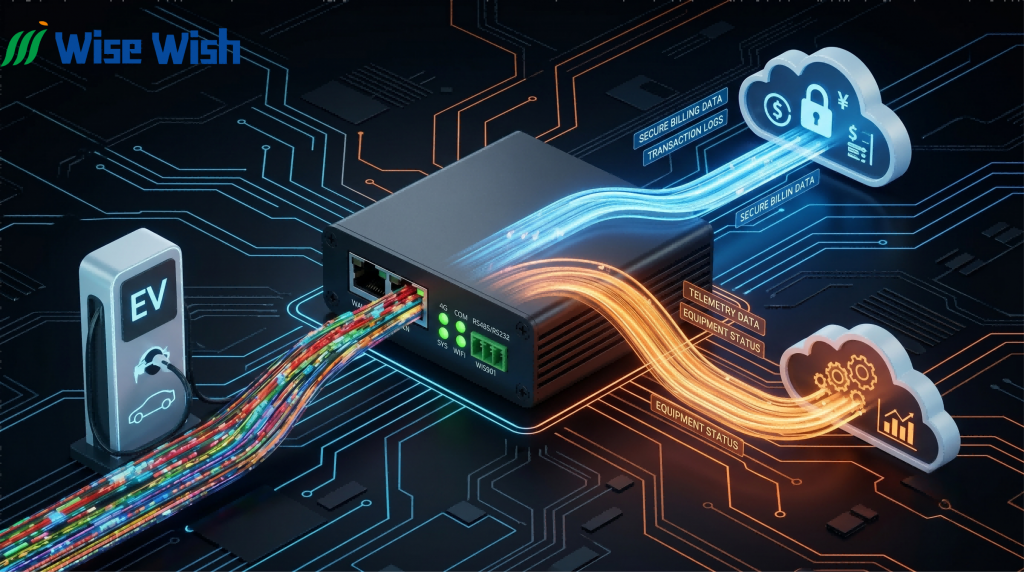
To thoroughly resolve the resource contention between “massive O&M Data” and the “core Value Stream,” modern IoT architectures introduce the OCPP Secure O&M Gateway and establish a Dual-Channel Architecture.
This architecture physically and logically decouples communication capabilities into two completely independent channels:
- Value Stream (Channel A): Dedicated to running the standard OCPP 1.6J/2.0.1 protocols. It only carries core business commands related to revenue (such as authorization and billing), ensuring zero friction when integrating with existing CSMS/billing systems and guaranteeing the highest SLA for core transactions.
- Health Stream (Channel B): Adopts MQTT over TLS or HTTPS protocols. It is specifically designed to carry 1Hz high-frequency telemetry data, component state-of-health (SOH), black-box diagnostic snapshots, and Secure Pass-through control.
Through this network-level and process-level isolation scheme, it not only eliminates privacy leaks and security compliance risks (sensitive user information is easily exposed in debugging logs under a single channel) but also establishes a secure O&M tunnel that only allows whitelisted commands to be dispatched, avoiding the exposure of SSH/Telnet ports to the public internet. Practical applications show that the dual-channel architecture can reduce the root-cause analysis time for complex faults by approximately 60% and significantly lower the frequency and cost of expensive on-site truck rolls.
“The Dual-Channel Architecture physically and logically decouples the OCPP Value Stream from the MQTT Health Stream, ensuring that high-volume diagnostic telemetry never degrades the real-time availability of critical EV charging billing transactions.”
Author Bio Jessie Expert in Industrial Network Connectivity and IoT Edge Architecture. She has long focused on the underlying edge secure gateway design and predictive maintenance solutions for new energy infrastructure and EV charging networks (OCPP ecosystems), dedicating herself to building high-availability, high-security next-generation communication infrastructures for large-scale device networks.