
Securing Legacy EV Charging Networks: Achieving Global Cybersecurity Compliance Without Hardware Replacement
As the global Electric Vehicle (EV) market expands rapidly, Electric Vehicle Supply Equipment (EVSE) has become critical national infrastructure. However, this rapid expansion masks a severe reality: there is a vast global inventory of existing charging stations, predominantly operating on early Open Charge Point Protocol (OCPP) versions (OCPP 1.5 or 1.6J), which heavily rely on plain-text communication. This architecture exposes millions of charging assets to critical risks such as data interception, man-in-the-middle (MITM) attacks, and Denial of Service (DoS) attacks.
With the enforcement of stringent international cybersecurity regulations—such as the UK’s Electric Vehicles (Smart Charge Points) Regulations 2021, the EU’s Radio Equipment Directive (RED), and the US NEVI Program—Charging Point Operators (CPOs) are facing a severe compliance crisis. In the UK alone, the regulations mandate encrypted communication, and non-compliance can result in severe penalties of up to £10,000 per device. The deadline for compliance is rapidly approaching, leaving operators searching for viable upgrade paths to secure their infrastructure.
The “Crypto-Agility” Crisis: Why Software Updates Fail
A common question among operators is why these old devices cannot simply be upgraded to modern encryption standards (such as TLS and mutual authentication) via an Over-The-Air (OTA) firmware update.
The answer lies in the physical limitations of early embedded Microcontrollers (MCUs), which constitutes a serious “Crypto-Agility” crisis. Early charging stations were often built with highly resource-constrained chips (such as Cortex-M3/M4 architectures) for cost control. These legacy MCUs face insurmountable physical bottlenecks when attempting to handle modern cryptographic protocols:
- Memory (RAM) Overflows: Modern TLS 1.2/1.3 protocol stacks require tens to over 100 KB of RAM to cache the certificate chain and encryption context during the handshake process. For many old MCUs, enabling TLS means there is insufficient memory to run core charging logic, leading to device crashes or watchdog resets.
- Computational (CPU) Paralysis: Asymmetric encryption algorithms (like RSA or ECC) are computationally intensive. On low-power MCUs, a TLS handshake can take several seconds, causing excessive delays, communication timeouts, and negatively impacting the real-time performance of charging control.
- Storage Limitations: Legacy devices often lack the secure Flash storage needed to dynamically manage root certificates and private keys securely.
Relying on software upgrades to force constrained hardware to support modern cybersecurity protocols is physically infeasible.
The Cost of “Rip and Replace” vs. Edge Computing
If software updates are impossible, the traditional alternative faced by CPOs is a complete “Rip and Replace” of existing charging stations. However, the economics of this approach are disastrous. Completing a full replacement for a Level 2 AC charger costs between $3,400 and $24,000, while replacing a DC Fast Charger can soar from $38,000 to over $210,000 when factoring in expensive civil works, excavation, and power access upgrades. Furthermore, the resulting downtime translates to weeks of lost revenue and customer churn.
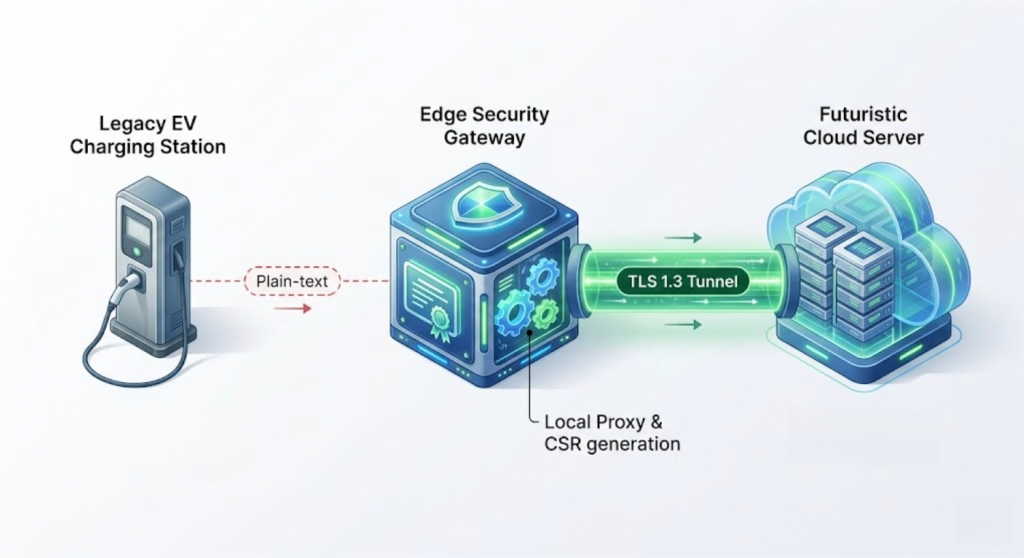
To bridge this gap, WiseWish Technology has engineered the OCPP Security Proxy Gateway—an innovative hardware intermediary layer deployed between the charging station and the internet.
Acting as a high-performance “security coprocessor”, the gateway utilizes a bi-directional “back-to-back” proxy mechanism. It simulates a local central server to accept the plain-text connection from the old charger, and simultaneously acts as a true OCPP client, establishing a highly encrypted TLS 1.3 tunnel to the cloud over the Wide Area Network. The charging station “believes” it is communicating with a standard non-encrypted server, while the cloud “sees” a connection that fully complies with the highest security standards.
Crucially, the gateway manages the entire certificate lifecycle natively. It utilizes its built-in high-performance Linux environment to intercept SignCertificate.req commands from the cloud, generate Certificate Signing Requests (CSR), manage private keys, and update root certificates transparently at the gateway layer—eliminating the need for costly on-site manual flashing.
Why Hardware Gateways Outperform Cloud Proxies
Some operators have experimented with “Cloud-to-Cloud” software proxies. However, these solutions fail to address the critical “first mile” of security. In a cloud proxy setup, data traveling from the charging station to the local Internet Service Provider (ISP) remains in plain text, completely exposed to interception and Man-in-the-Middle (MITM) attacks at the local network level.
The WiseWish hardware gateway solution completes encryption directly at the physical edge. It is the only approach that truly closes the loop on “end-to-end” security, offering an irreplaceable advantage in addressing local area network (LAN) vulnerabilities.
Beyond Encryption: Defense in Depth and Future-Proofing
By achieving the stringent EU EN18031 cybersecurity certification, the WiseWish OCPP Security Proxy Gateway provides a complete “Defense in Depth” enterprise-grade system for legacy stations.
- Intrusion Detection: Its built-in Intrusion Detection System (IDS) is capable of real-time traffic monitoring, identifying and blocking Denial of Service (DoS) attacks aimed at the charging station, effectively acting as a “24-hour digital bodyguard”.
- Secure Storage: All TLS private keys and authentication credentials are encrypted and securely stored, ensuring core keys cannot be extracted even if the gateway is physically disassembled.
Beyond compliance, the gateway can translate modern OCPP 2.0.1 instructions from the cloud into simple OCPP 1.6J commands, seamlessly enabling Demand Response and Smart Charging capabilities for legacy assets. Furthermore, as an independent computing unit possessing true “Crypto-Agility”, it is prepared to support future Post-Quantum Cryptography (PQC) algorithms through simple software updates.
Conclusion
WiseWish Technology’s OCPP Security Proxy Gateway is not just a technical patch; it is a strategic asset preservation tool. For a fraction of the cost of hardware replacement—typically $200 to $400 per unit—CPOs can bypass insufficient physical hardware capabilities, instantly achieve global regulatory compliance (including UK OPSS and EU RED/EN18031), and extend the lifecycle of their infrastructure without a single day of downtime.
About WiseWish Technology: WiseWish Technology specializes in industrial network connectivity and IoT edge computing architectures. We are dedicated to providing enterprise-grade cybersecurity defense systems and digital empowerment solutions for the global Electric Vehicle Supply Equipment (EVSE) sector. By integrating our advanced edge intelligent devices, we enable CPOs to seamlessly transition legacy assets into the next generation of secure, smart-managed energy grids.
Bid farewell to pure cloud-based proxies with potential security risks, and fortify your edge networks with genuine hardware-level encryption. Click to explore WiseWish’s https://wisewish.net/wis906/ , and learn how our innovative dual-channel intelligent O&M architecture effortlessly addresses compliance challenges for legacy charging facilities.