
Bridging Cloud Software and Edge Hardware: The Blueprint for Zero-Fallout EV Charging O&M
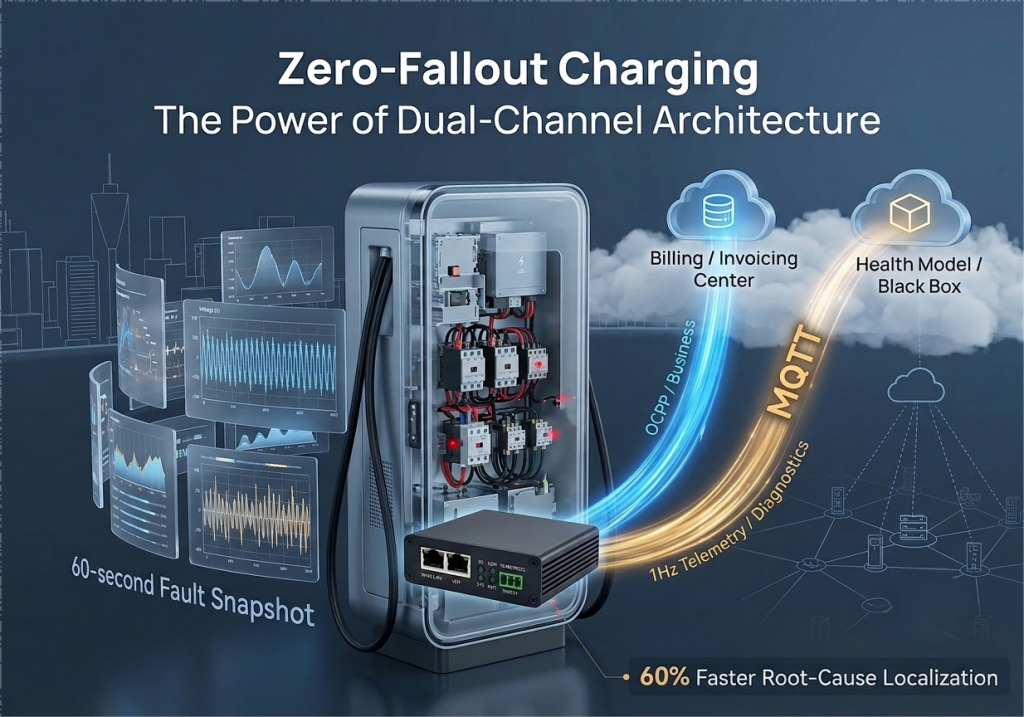
As EV charging infrastructure scales globally, operators are facing a critical bottleneck: Operations and Maintenance. While modern open-source CSMS platforms are introducing brilliant software features—like gracefully taking stations offline for maintenance without driver fallout—these cloud systems are only as smart as the data they receive from the edge.
Currently, mainstream deployments rely on a single OCPP channel to handle both business transactions and limited diagnostics. This approach leads to insufficient observability, making it incredibly difficult to build reliable health models for predictive maintenance. When complex failures occur, operators are forced into expensive, time-consuming “truck rolls” to physically capture logs and waveforms.
The Missing Link: Edge Hardware Observability
To truly realize the potential of advanced CSMS scheduling features, we must look at the hardware layer. This is why the OCPP Secure O&M Gateway physically and logically decouples communication into two collaborative channels:
- The Value Stream (Channel A): Dedicated strictly to OCPP business transactions (Authorize, Start/Stop, MeterValues), seamlessly connecting to the billing engine.
- The Health Stream (Channel B): A dedicated MQTT/HTTPS channel carrying 1 Hz electrical telemetry, component health (such as contactor cycles and gun lock actions), and remote diagnostics.
The Perfect Synergy: Edge Triggers Meet Cloud Scheduling
Imagine a scenario where a charging pile begins to experience abnormal module temperatures or internal BMS errors.Relying solely on standard OCPP status reporting is often too slow or lacks granularity. However, with a dual-channel architecture, the WIS901 gateway can capture a “Black Box Snapshot”. This automatically freezes a 30-60 second data window around the fault moment, capturing grid voltage, current curves, and internal error registers.
This hardware-level trigger can instantly communicate with a modern CSMS to activate a “Site Maintenance Mode.” The system can automatically isolate the specific faulted pile, stopping future drivers from experiencing a failed session, while the “Black Box” snapshot is uploaded via Channel B for remote post-mortem analysis.
Security Compliance and Privacy Protection
Transmitting transaction data alongside debug logs over a single channel carries significant compliance risks of sensitive information disclosure. Our dual-channel architecture transmits desensitized information streams via MQTT on the health stream, in full compliance with privacy protection requirements.
Practical applications of this dual-channel architecture have shown that fault root-cause localization time can be reduced by approximately 60%, significantly improving equipment availability and SLA compliance.
Software platforms are building the brain for next-generation charging networks. With secure edge gateways, we are providing the highly sensitive nervous system required to make proactive O&M a reality.