
Beyond Broken Cables: The Hidden Protocol Crises Eating Up EV Charging O&M Time
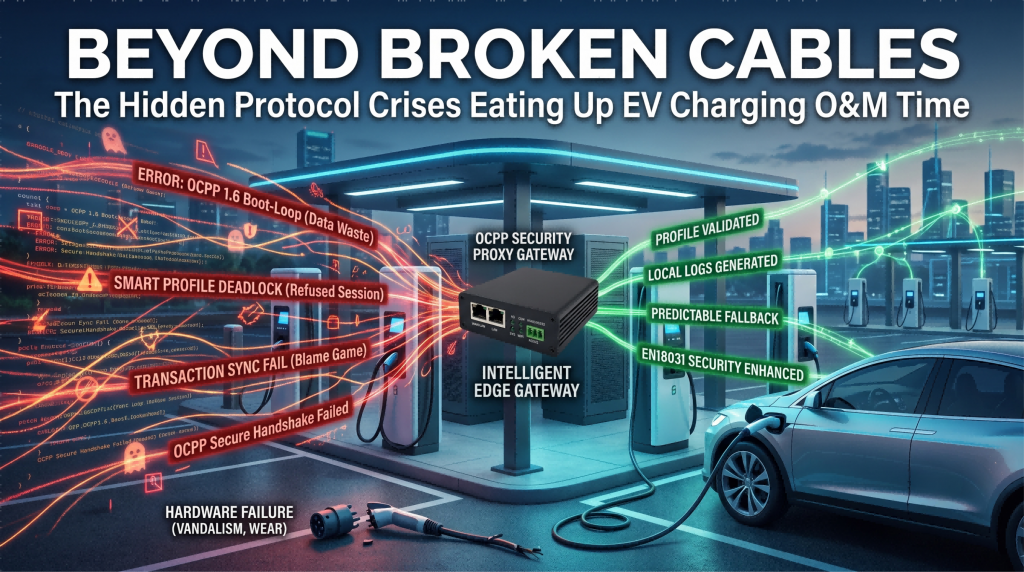
When we talk about EV charging infrastructure reliability, the conversation often centers on hardware: vandalized plugs, cracked screens, or wear-and-tear.
But if you talk to field Operations and Maintenance (O&M) engineers running large-scale networks, you quickly realize the real ghosts in the machine are invisible. They live within the communication layer, the OCPP handshake, and backend desynchronization.
I recently initiated a discussion with several network administrators and O&M professionals regarding their biggest real-world time-sinks. The feedback was eye-opening and points to a critical shift needed in how we architect EV charging connectivity.
Here are the three most pervasive “hidden” issues plaguing O&M teams today—和 how edge intelligence can fix them.
1. The “Smart Profile” Deadlock
Smart charging is essential for grid balancing, but in the wild, it is a frequent point of failure. O&M teams report that orphaned or conflicting Smart Charging Profiles sent by the CSMS (Charge Point Management System) routinely cause chargers to drop power or refuse to initiate sessions entirely.
Worse yet, when communication drops, the offline fallback strategies of many chargers are unpredictable—either defaulting to zero power or dropping from a fast 350kW to a sluggish 75kW.
- The Fix: We cannot rely solely on the cloud to manage these state machines. The edge network needs to act as a logic filter, validating incoming OCPP profiles before they reach the controller and executing clean, local fallback scripts if the backend goes dark.
2. The Firmware Boot-Loop and Data Disasters
We’ve all heard of firmware updates fixing bugs, but what happens when a CSMS continuously pushes an incompatible update? One O&M engineer shared a horror story of a charger that, upon every boot, attempted a flawed update, failed, and restarted.
The result? Near-zero uptime and astronomical cellular data costs for the operator, as the charger mindlessly downloaded gigabytes of useless data.
- The Fix: Devices at the edge must have native intelligence. An intermediate proxy layer can intercept firmware delivery, verify checksums and version compatibility locally, and implement exponential backoff algorithms to prevent runaway data consumption.
3. The Multi-Platform “Blame Game”
When a “Plug & Charge” session fails or a transaction syncs incorrectly, where does the fault lie? Is it the vehicle’s hardware, the roaming protocol (OCPI), the CPO backend, or a cellular dropout?
Because standard chargers often lack robust local logging or simply transparently pass data through, diagnosing these intermittent synchronization issues turns into a massive game of finger-pointing between vendors, costing weeks of diagnostic time.
- The Fix: Moving away from “dumb” passthrough routers. By utilizing an intelligent gateway that acts as a local “black box,” operators can log precise OCPP traffic and environmental states locally. When a sync issue occurs, you don’t guess—you look at the edge ledger.
Shift the Paradigm: From Passthrough to Proxy
The recurring theme from the field is clear: The cloud cannot manage every edge-case micro-transaction in real-time over unpredictable cellular networks.
Relying on a standard router to blindly pass traffic between a vulnerable charger and a distant CSMS is no longer enough. To achieve true uptime and robust security compliance (such as EN18031 requirements), the industry must adopt OCPP Security Proxy Gateways.
By moving protocol validation, security enforcement (upgrading legacy profiles to secure TLS-encrypted channels), and smart caching to an intelligent edge gateway, we shield the charger from bad backend data and bad actors alike.
It’s time to stop treating connectivity as just a pipe, and start treating it as the intelligent frontline of O&M defense.
#EVCharging #OCPP #EVInfrastructure #EdgeComputing #SmartGrid #OperationsAndMaintenance