
Deep Protection for Modbus and SIEM Integration in Legacy Industrial (OT) Environments
Technical Guidance for Industrial Network Security Modernization
1. Introduction and Background: The Security Deficit of Legacy Industrial Systems
In the era of the modern Industrial Internet of Things (IIoT) and enterprise digital transformation (IT/OT convergence), securely and efficiently uploading data from traditional production sites to the cloud or upper-level monitoring systems has become a core demand. However, the vast majority of Industrial Control Systems (ICS) and Programmable Logic Controllers (PLCs) deployed on-site were designed years ago and suffer from a significant “security deficit”:
- Inherent Protocol Flaws: Traditional baseline industrial protocols such as Modbus RTU/TCP generally transmit data in plaintext, lacking built-in mechanisms for authentication, access control, and encryption.
- Asset Modernization Dilemma: Legacy equipment on production lines cannot bear the high cost of complete replacement, nor can it directly support security patches or advanced firewall software.
- Boundary Protection Failure: With the deep integration of IT and OT networks, traditional “physical isolation” has been dismantled, and malicious attacks from external networks or lateral movements pose serious threats to critical infrastructure.
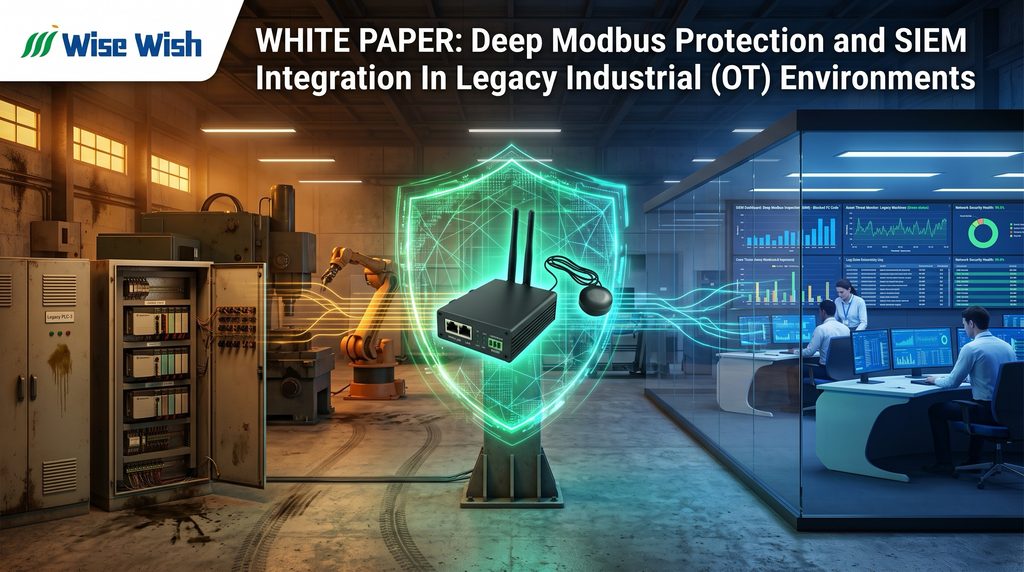
To address these pain points without interrupting production or replacing existing legacy hardware, a surgical-grade, fine-grained protection architecture based on the Edge Security Proxy Gateway has emerged.
2. Core Architecture and Protection Strategies: Edge Gateway Defenses
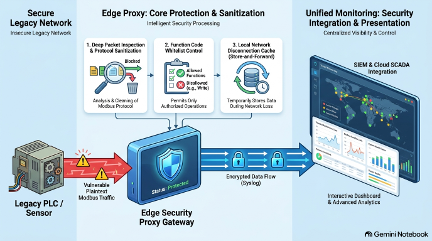
The Edge Security Proxy Gateway is deployed at the physical boundary of the OT environment, situated between the underlying legacy PLCs and the upper-level network or cloud systems. Its core protection philosophy moves away from coarse-grained traditional IP/port firewalls, instead combining Deep Packet Inspection (DPI)-based function code whitelisting with network isolation.
2.1 Fine-Grained Deep Packet Inspection and Function Code Whitelisting
- On-Demand Authorization of Compliant Commands: For the Modbus protocol, the gateway inspects not only the network layer (IP/Port) but also deep into application layer packets. Administrators can configure strict function code whitelists based on business needs. For example:
- Allowed: Legitimate read operations, such as Read Holding Registers (03) and Read Input Registers (04).
- Allowed: Specifically authorized single-point write operations, such as Write Single Register (06).
- Actively Blocked: All unauthorized or high-risk operations, such as illegal bulk writes, remote firmware flashing, diagnostic reset commands, etc.
- Significant Reduction of Attack Surface: By filtering traffic based on this “least privilege principle,” even if the external network is compromised, attackers cannot issue malicious control commands to the underlying PLCs through the Modbus communication channel.
2.2 Protocol Conversion and Encrypted Outbound Transmission
The gateway terminates fragile industrial plaintext protocols locally, converts them into structured data (such as JSON/MQTT), and securely uploads them to the cloud or upper-level systems via secure proxy tunnels (such as TLS, encrypted VPN tunnels, or REALITY obfuscation proxies), completely eliminating the risks of eavesdropping and tampering during transmission.
3. SIEM Integration and Unified Security Operations Center (SOC)
In a distributed factory environment, merely “blocking attacks” at the edge is no longer sufficient to meet enterprise-level compliance and security operations requirements. Security teams need to aggregate threat awareness capabilities from the edge into the enterprise’s unified Security Operations Center (SOC).
The Edge Security Gateway is designed with standardized open interfaces and log pipelines to achieve seamless integration with mainstream SIEM (Security Information and Event Management) tools.
3.1 Standardized Logs and Multi-Format Outputs
- Event Auditing: The gateway records all abnormal access attempts, whitelist block events, protocol parsing errors, and system status in real time.
- Standard Format Support: All security audit logs and alert events can be converted into standard industrial/IT security formats, such as Syslog (RFC 5424) and CEF (Common Event Format), ensuring direct parsing by third-party platforms.
3.2 Mainstream SIEM Platform Compatibility
The Edge Gateway supports out-of-the-box integration with the following mainstream enterprise SIEM and big data analysis platforms:
- Splunk
- Elasticsearch / ELK Stack
- Microsoft Sentinel
- IBM QRadar
3.3 High-Availability Transmission Guarantee Mechanism
- Transmission Encryption: The log return channel from the Edge Gateway to the SIEM platform is mandated to use TLS encryption to prevent log data from being tampered with during transmission.
- Local Network Disconnection Cache (Store-and-Forward): When the local network experiences transient fluctuations or disconnects from the headquarters, the gateway’s built-in high-capacity local storage (SSD/flash memory) automatically caches security logs. Once the network is restored, data retransmission resumes from the breakpoint, ensuring zero data loss of SOC audit data and compliance integrity.
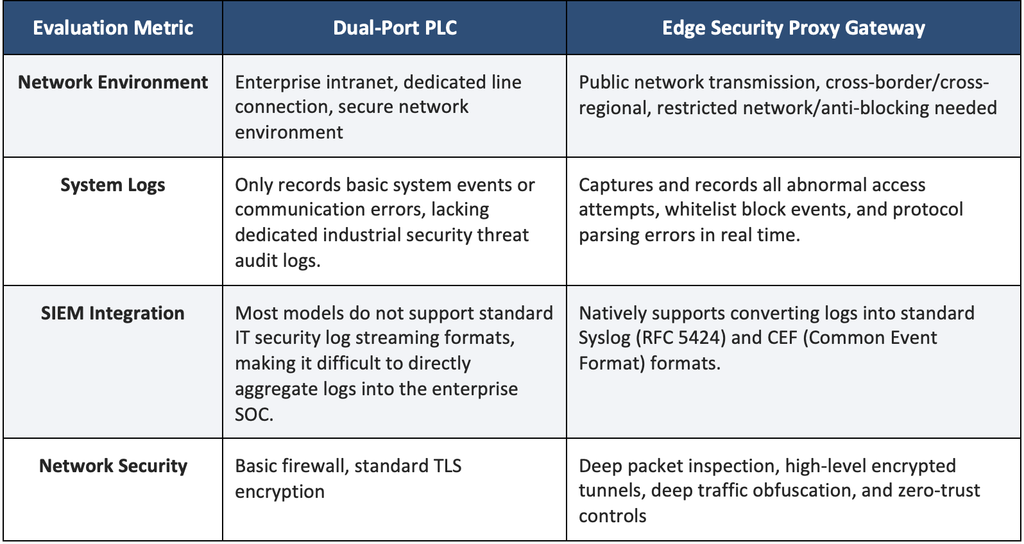
4. Comparison: Edge Security Proxy Gateway vs. Dual-Port PLC
To better understand the distinct advantages of the Edge Security Proxy Gateway in securing industrial control systems, a side-by-side comparison with a standard Dual-Port PLC across key operational and security metrics is detailed below:
5. Summary of Solution Value: Cost-Effective Security and Global Visibility
By introducing the Edge Security Proxy Gateway, enterprises can achieve the following core benefits without modifying existing industrial topologies or replacing expensive legacy equipment:
- Cost-Effective Retrofit Protection: Adds a robust “digital bulletproof vest” to mainstream legacy PLCs with minimal modification costs.
- Precise Defense (Minimized Attack Surface): Eliminates unauthorized control and malicious commands at the source through deep packet inspection based on Modbus function code whitelists.
- Global Visibility (SIEM Closed-Loop): Seamlessly synchronizes edge-side threat confrontation events to the enterprise’s SIEM system, realizing unified threat monitoring, rapid response, and compliance auditing for global and factory-wide assets.