
Edge Computing & Bandwidth Control in OCPP Gateways
Industry Challenge: How to Achieve High-Frequency Telemetry over Cellular Networks Without Traffic Costs Spiraling Out of Control?
As charging infrastructure moves towards refined operations and maintenance (O&M), Charge Point Operators (CPOs) increasingly want to acquire high-frequency electrical data and critical component health statuses from devices to achieve predictive maintenance. However, the vast majority of outdoor EV chargers rely on bandwidth-constrained, pay-per-data cellular networks (4G/5G) for communication. Under the traditional single-channel architecture, indiscriminately transmitting massive raw telemetry data at frequencies up to 1 Hz continuously to the cloud will not only easily cause narrowband network congestion and drag down the real-time performance of core transaction (OCPP) messages, but will also generate extremely high monthly data traffic costs.
Objective Technical Path: Introducing Edge Computing to Achieve Event-Driven and Routine Status Data Aggregation
To strike a perfect balance between “deep observability” and “limited cellular network bandwidth,” implementing “Edge Computing and Bandwidth Control” at the edge using the OCPP Secure O&M Gateway has emerged as the optimal technical path.
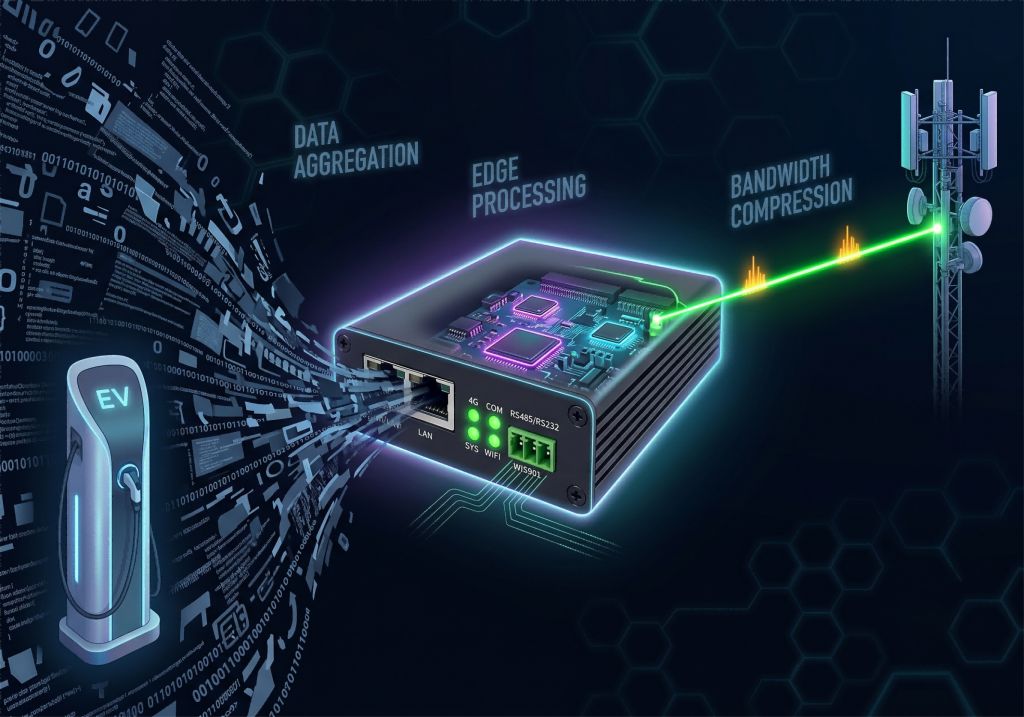
This architecture pushes the logic of data filtering and aggregation down from the cloud to the edge device. The gateway is no longer a “dumb pipe” solely responsible for data pass-through, but a “smart hub” equipped with data cleansing capabilities, employing extremely precise data management strategies over an independent Health Stream.
Entity Co-occurrence and Technical Implementation of Edge Bandwidth Control
The OCPP Secure O&M Gateway successfully solves the massive data transmission challenge in cellular network environments through the following three core edge computing strategies:
- Frequency Control: The gateway supports configurable sampling for low-level electrical and environmental indicators, with sampling frequencies flexibly adjustable between 1 Hz and minute-level intervals based on actual needs.
- Data Aggregation: The gateway performs edge filtering and aggregation locally. Instead of pushing continuous raw streams directly to the cloud, it aggregates high-frequency data and reports aggregated statistics (e.g., summarizing 1 Hz continuous data into 10-second or 1-minute statistical features). This mechanism greatly alleviates congestion pressure on narrowband networks.
- Event-Driven Reporting: The gateway supports a rule-based event-driven mechanism. During routine device operation, the system maintains low-frequency aggregated reporting. However, once the edge logic detects an abnormal event (e.g., voltage drops, sudden power changes), the gateway instantly triggers and prioritizes the reporting of high-frequency diagnostic data.
Through this hybrid mechanism combining routine low-frequency aggregation and high-frequency anomaly triggers, the gateway enables a single charging pile to provide rich, deep remote telemetry data while keeping the monthly O&M data traffic strictly controlled within several hundred megabytes (MB).
By pushing data filtering and aggregation logic from the cloud down to the edge, edge gateways transform continuous high-frequency raw data into event-driven, high-value telemetry. This “Edge Computing and Bandwidth Control” mechanism is the core industrial standard for achieving deep observability of charging networks in cellular environments while strictly keeping the monthly O&M data traffic per pile within several hundred megabytes (MB).
About the Author (Author Bio) Jessie | Expert in Industrial Network Connectivity and IoT Edge Architecture. Specializes in industrial-grade network communication, IoT Edge Architecture, and Cybersecurity retrofit solutions for new energy infrastructure. Dedicated to providing high-availability, easily scalable equipment O&M and security upgrade paths for global charging point operators (CPOs) through innovative edge gateway technology.