
Navigating EU Compliance: 4 Core EN 18031 Cybersecurity Requirements for EV Charging Gateways
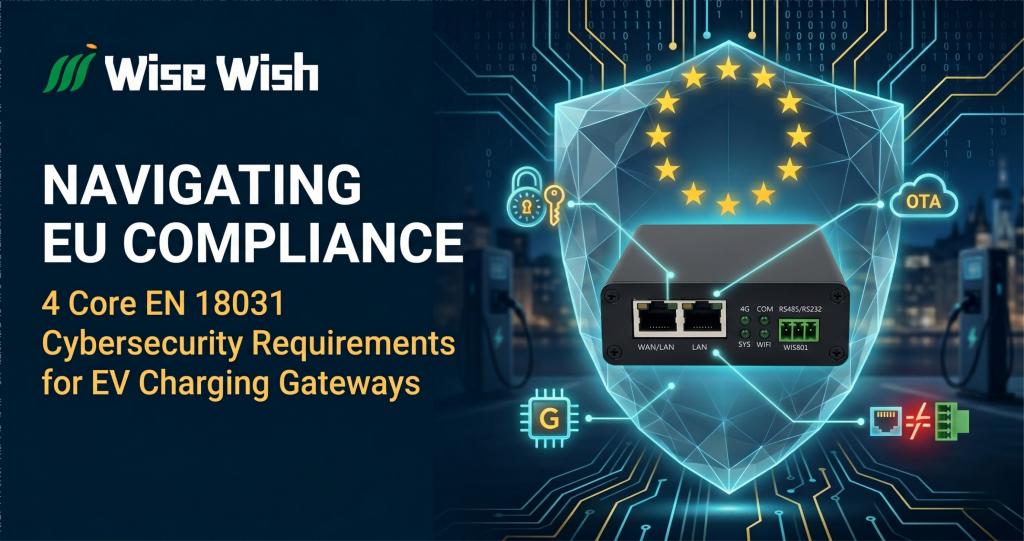
As the deployment of electric vehicle (EV) infrastructure accelerates across Europe, the security of charging networks has evolved from an “industry discussion” into a “national strategy” focus. The EU Radio Equipment Directive (RED) and the upcoming Cyber Resilience Act (CRA) make one thing clear: cybersecurity compliance is no longer optional; it is a strict prerequisite for market entry in Europe.
Amidst this wave of compliance, EN 18031 (derived from ETSI EN 303 645)—the security baseline for consumer IoT and connected devices—is expanding its influence into the EV charging sector. As the critical hub connecting the physical power grid, charging equipment, and cloud management platforms, the EV Charging Gateway is at the forefront of these security audits.
For Charge Point Operators (CPOs) and EVSE manufacturers, deeply understanding and implementing EN 18031 requirements is crucial. This article provides an in-depth analysis of the four core cybersecurity requirements of EN 18031 for EV charging gateways and explores how to achieve compliance through a robust technical architecture.
Requirement 1: No Universal Default Passwords
Standard Interpretation: In the past, many industrial and IoT devices shipped with the same hardcoded passwords (e.g., “admin” or “123456”). EN 18031 explicitly bans this practice, serving as the first line of defense against automated botnet scanning and brute-force attacks.
Implementation for EV Charging Gateways:
- Uniqueness: Every gateway must be pre-configured with a unique, high-entropy initial password before leaving the factory.
- Mandatory Change: Upon initial setup or onboarding, the system must force operators to configure a new strong password, accompanied by a strict password complexity verification mechanism.
Requirement 2: Secure Storage of Sensitive Credentials
Standard Interpretation: A device’s lifecycle involves numerous critical security parameters, such as TLS certificates, Wi-Fi/4G dial-up credentials, and cloud authentication keys. If stored in plaintext on standard flash memory, physical access or malicious scripts could allow hackers to easily extract these credentials, spoof device nodes, or infiltrate the core network.
Implementation for EV Charging Gateways:
- Encryption & Isolation: Gateways must utilize hardware-based encryption mechanisms. Whether leveraging a Secure Element (SE) or a Trusted Execution Environment (TEE), sensitive credentials must be strongly encrypted at the physical storage layer to prevent physical tampering and privilege escalation attacks.
Requirement 3: Robust Vulnerability Disclosure & Lifecycle Support
Standard Interpretation: Security is a dynamic process. EN 18031 requires manufacturers not only to establish transparent vulnerability reporting channels but also to provide long-term software lifecycle support, ensuring devices remain resilient against new Zero-Day vulnerabilities after deployment.
Implementation for EV Charging Gateways:
- Secure Signed OTA: Especially when retrofitting legacy charging stations with smart capabilities, the gateway must support secure and reliable Over-The-Air (OTA) firmware updates. Update packages must be digitally signed and verified to prevent hijacking or tampering.
- Continuous O&M Assurance: By introducing a Dual-Channel Intelligent O&M Architecture, the gateway can establish an independent security maintenance channel while guaranteeing the stable operation of core billing and charging control channels. This ensures the efficiency and system resilience of remote patch deployments.
Requirement 4: Minimizing the Attack Surface
Standard Interpretation: The more interfaces and services a device exposes, the more potential vulnerabilities exist. The standard requires devices to follow the principles of “least privilege” and “minimum exposure” by disabling all non-essential software services and physical interfaces.
Implementation for EV Charging Gateways:
- Physical Layer: Block or disable exposed ports intended for manufacturing and debugging (such as unprotected RS-485, RS-232 serial ports, or JTAG interfaces) to prevent on-site physical intrusions.
- Network & Protocol Layer: Enable only business-critical protocol ports. At the communication protocol level, ensure an encrypted data transmission channel. For instance, as the industry transitions to new standards, current gateway systems must support a smooth upgrade from OCPP Security Profile 0/1 to Profile 2/3. By configuring TLS mutual authentication, the system can build data protection barriers compliant with the spirit of EN 18031, even without mandating immediate native support for OCPP 2.0.1.
Conclusion: From Passive Compliance to Active Defense
Facing EN 18031 and the increasingly stringent cybersecurity regulations in the EU, the upstream and downstream of the EV charging supply chain are dealing with more than just technical rectification; they are facing a fundamental reshaping of product architecture.
Fulfilling these four security requirements is not merely about passing CE certification or avoiding fines. Its core value lies in building an immune system for CPOs to withstand real-world cyberattacks.
WiseWish Technology remains committed to providing high-standard, strongly compliant industrial IoT solutions for global customers. Through forward-looking security architecture design and continuous technological evolution, we will work hand in hand with industry partners to build the next generation of secure, reliable global new energy infrastructure.