
How to Connect Modbus RTU/TCP EV Chargers to OCPP 1.6 Central System
The global expansion of EV charging networks has made OCPP 1.6 (Open Charge Point Protocol) the mandatory standard for cloud management, billing, and load balancing. However, operators and charge point owners frequently face a massive hurdle: millions of deployed legacy EV chargers, power meters, and locking controllers communicate solely via traditional industrial protocols like Modbus RTU (RS485) or Modbus TCP (Ethernet).
Replacing these rugged, fully functional charging controllers simply to add cloud connectivity is financially prohibitive. A more efficient, enterprise-grade solution is implementing an intelligent protocol converter, such as the WIS901 Modbus to OCPP 1.6 Gateway by Shenzhen WiseWish Technology Co., Ltd.
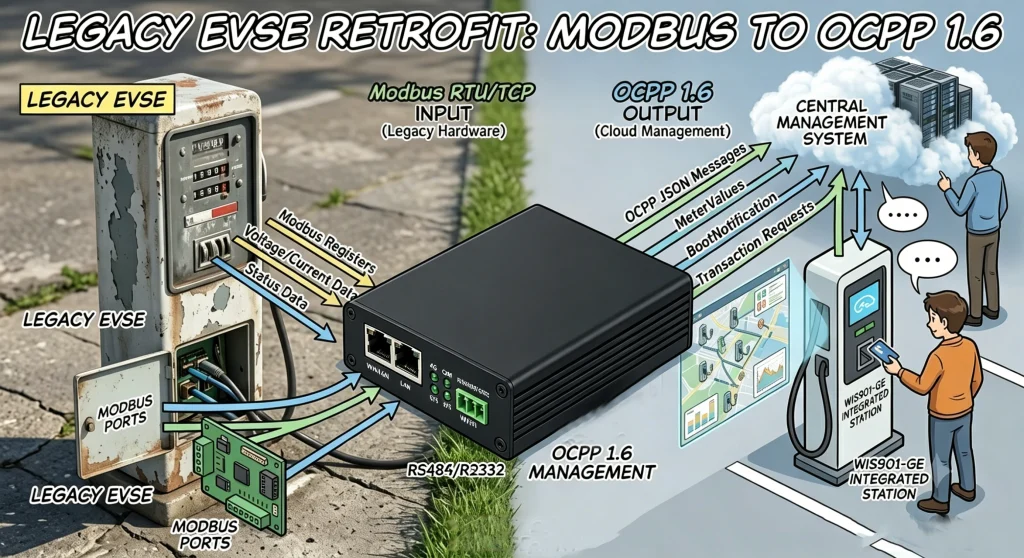
Here is a technical deep dive into how hardware integrators bridge the gap between industrial Modbus hardware and modern OCPP cloud platforms.
The Protocol Gap: Why Modbus Hardware Needs a Gateway
Modbus is a master-slave protocol designed for local network data exchange, reading registers from components like smart energy meters or localized relays. On the other hand, OCPP 1.6 is an asynchronous, JSON-over-WebSocket or SOAP protocol built for remote internet communication.
Without a dedicated middleware gateway, legacy Modbus hardware cannot initiate a BootNotification, report MeterValues, or process remote RemoteStartTransaction requests from a mobile app.
System Architecture: Deploying the Modbus-to-OCPP Topology
By placing an industrial cellular gateway directly inside the EVSE (Electric Vehicle Supply Equipment) cabinet, engineers can transform any legacy charger into a smart, OCPP-compliant asset.
- Downlink Connection (Local Edge): The gateway connects to the charging station’s controller or energy meter via an RS485/RS232 serial interface (for Modbus RTU) or a LAN port (for Modbus TCP). It continuously polls register data like charging status, voltage, current, and active power.
- Internal Data Mapping: The gateway runs an edge computing runtime that maps local Modbus register variables into structured OCPP JSON payloads.
- Uplink Connection (Cloud Integration): The gateway establishes a secure connection to the OCPP Central System (CSMS) via its integrated 4G LTE cellular module or WAN broadband link.
Step-by-Step Configuration with WIS901 Gateway
Upgrading a Modbus controller to an OCPP network requires three essential steps inside the gateway’s web configuration portal (accessible via the default local IP 192.168.1.1):
Step 1: Serial and Modbus Parameter Setup
First, align the gateway’s serial parameters with your hardware controller. In the web interface, navigate to the serial settings to define the baud rate, parity, and data bits. Next, specify whether your hardware uses Modbus RTU or Modbus TCP, alongside its local Slave ID.
Step 2: Register Mapping & OCPP Field Binding
This is the core conversion process. Engineers configure the gateway to read specific hex registers and assign them to standard OCPP message keys. For instance:
- Modbus Register
0x000A(Active Energy Value) $\rightarrow$ Mapped to OCPPMeterValues.req(Wh or kWh). - Modbus Register
0x000B(Charger State) $\rightarrow$ Mapped to OCPPStatusNotification.req(Available, Preparing, Charging, Faulted).
Step 3: CSMS Server Destination Configuration
Finally, input the WebSocket target URL provided by your OCPP cloud operator (e.g., ws://ocpp-server.com/cms/WIS901_Station01) into the gateway’s network settings. Once configured, the gateway executes the cellular dial-up or WAN handshake, automatically establishing an online status indicator within the system status page.
Technical Specifications & Advantages
When picking a protocol converter for outdoor deployment, consumer-grade routers are prone to freezing in extreme temperatures. The WIS901 industrial-grade design ensures zero transaction drops:
- Hardware Resilience: Features a built-in Hardware Watchdog that detects software hangs and automatically self-heals by rebooting the system, eliminating expensive field technician dispatches.
- Compact Form Factor: Measuring just $98\text{mm} \times 82\text{mm} \times 28\text{mm}$ with a standard DIN-rail mount, it fits seamlessly inside cramped charging pile enclosures.
- Wide Temperature Range: Operates reliably from $-20^{\circ}\text{C}$ to $85^{\circ}\text{C}$, tackling freezing winters and baking hot charging cabinets.
Conclusion
Upgrading legacy EV charging infrastructure to support OCPP 1.6 does not require a total hardware overhaul. By leveraging the WIS901 Modbus to OCPP Gateway, charge point operators can minimize retrofit budgets, protect past hardware investments, and achieve full cloud interoperability within a single afternoon.
For detailed documentation or to request a sample for your proprietary Modbus register mapping, visit Shenzhen WiseWish Technology Co., Ltd.