
The Next-Generation Smart Charging Network Architecture
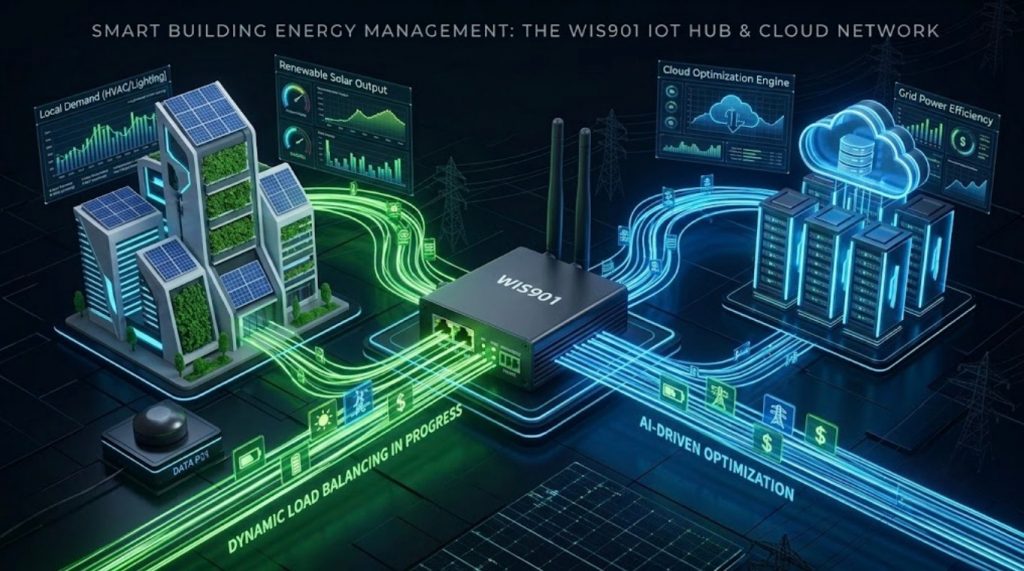
With the widespread adoption of Electric Vehicles (EVs), Building Management Systems (BMS) are facing unprecedented challenges. How can we ensure local grid stability and dynamic load management while facilitating efficient cloud-based operations and centralized dispatching? This has become a critical objective for property managers, fleet operators, and Charge Point Operators (CPOs).
Today, we provide an in-depth look at a comprehensive charging system architecture that perfectly integrates local OT control with cloud-based IT operations—completely bridging the gap between local Operational Technology (OT) networks and cloud-based Information Technology (IT) platforms.
🌟 The Core Engine: WiseWish Gateway
In this innovative architecture, the WiseWish Gateway plays a crucial role as the edge communication and security bridge. Based on strict EN 18031/CRA cybersecurity certification, the WiseWish Gateway flawlessly handles bi-directional protocol mapping and data aggregation between local industrial buses and cloud services.
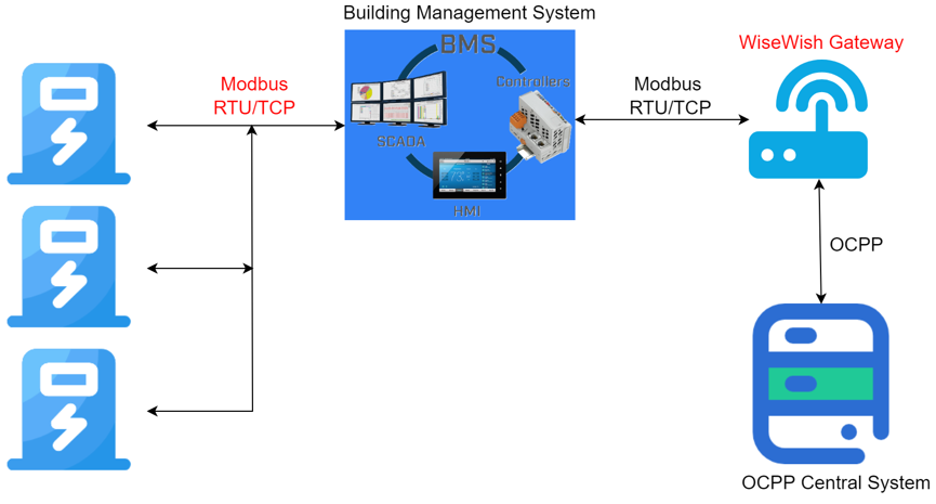
It seamlessly connects the underlying Electric Vehicle Supply Equipment (EVSE) with the local Building Management System (BMS), and more importantly, builds a secure bridge to the remote OCPP Central System (CSMS).
⚡ Seamless Protocol Translation for Free-Flowing Data
Our system ingeniously leverages low-latency, deterministic industrial protocols for local field control alongside high-extensibility web protocols for cloud management. Through the WiseWish Gateway, highly efficient upstream and downstream communication is achieved across the EVSE, BMS, and cloud platforms.
| Communication Path | Protocol | Role and Functionality |
| EVSE ↔ BMS | Modbus RTU / TCP | Industrial fieldbus standard for low-latency telemetry acquisition and real-time control command execution. |
| BMS ↔ WiseWish Gateway | Modbus RTU / TCP | Local area network protocol for transferring aggregated EVSE telemetry and load status to the gateway. |
| WiseWish Gateway ↔ OCPP CSMS | OCPP (over WebSocket/TLS) | International open standard protocol for high-level operations, management, and charge point communication. |
💡 Core Advantages: Why Choose Our Integrated Architecture?
By adopting this WiseWish Gateway-based architecture, your charging network will gain three core capabilities:
- Dynamic Load Management (DLM) & Grid Protection: The BMS continuously monitors total facility power consumption. During peak demand periods, the system intelligently throttles EVSE output power via Modbus to prevent main breaker tripping; power output automatically restores during off-peak hours, achieving smart energy management and grid protection.
- Legacy Device Cloud Enablement: For legacy EVSE lacking native OCPP network capability and only supporting industrial protocols like Modbus, there is no need for costly hardware replacements. By aggregating them through the local BMS, the WiseWish Gateway can translate their data into standard OCPP protocols, easily exposing them to cloud platforms.
- Dual-Tier Monitoring & Resilience: CPOs can manage highly efficient centralized billing, user authorization, and fleet management remotely on the cloud CSMS platform; meanwhile, facility engineers maintain real-time offline visibility and manual override capability through local HMI/SCADA interfaces, providing true dual-layer reliability.
🛡️ Military-Grade Protection: Four-Tier “Defense-in-Depth” Security Framework
In the era of IoT, network and electrical safety cannot be compromised. To address both Operational Technology (OT) and Information Technology (IT) security requirements, our architecture enforces a robust four-tier Defense-in-Depth security framework:
- First Line of Defense – Physical & Network Domain Isolation: The local OT field domain operates within an isolated LAN and exposes no inbound ports to the public Internet. Even in the event of a cloud-side DDoS attack or WAN outage, the local BMS continues operating independently, maintaining critical load shedding and electrical protections.
- Second Line of Defense – Protocol Gateway & Boundary Ingress Control: Acting as the single security proxy between domains, the WiseWish Gateway not only performs strict packet inspection and sanitization to prevent command injection, but also utilizes OCPP over WebSocket with TLS 1.2/1.3 encryption to defend against Man-in-the-Middle (MitM) attacks and data tampering.
- Third Line of Defense – Principle of “Local Safety Primacy”: Control hierarchy is clearly defined. While the cloud retains business-level orchestration rights (like billing), the local BMS controller maintains overarching priority for emergency shutdowns and overcurrent protection. Any anomalous or hazardous command from the cloud will be directly rejected by the local BMS based on real-time sensor measurements, firmly defending the physical grid safety baseline.
- Fourth Line of Defense – Strict Identity & Access Control: The gateway authenticates with the cloud using mutual TLS (mTLS) with client certificates to prevent rogue gateway enrollment; locally, the BMS HMI enforces strict Role-Based Access Control (RBAC) to mitigate unauthorized physical tampering or operational errors.
🚀 Conclusion
The innovative integrated BMS-OCPP architecture not only provides a standardized technical paradigm for the deep integration of smart buildings and green transportation, but also guarantees operational flexibility and efficiency while protecting underlying electrical assets and network boundaries.
Want to learn how the WiseWish Gateway can upgrade your charging infrastructure? Contact our technical experts today to get the full white paper or schedule a system demonstration!