4G Gateways for EV Charging Reliability
As the global adoption of electric vehicles (EVs) accelerates, the infrastructure supporting them must keep pace. Outdoor EV charging stations are often deployed in remote areas, highways, and unmanned parking lots. For operators, network downtime is the ultimate profit killer. When a charging pile loses connection, payment processing fails, user sessions drop, and remote management becomes impossible.
To ensure 24/7 uninterrupted connectivity for smart charging infrastructures, system integrators rely on robust solutions like the WIS901-GE General 4G Industrial Gateway56. Here is how its dual-layer reliability network design eliminates downtime in outdoor EV charging deployment.
The Pain Point: High Costs of Unattended Station Maintenance
Unlike indoor commercial networks, outdoor EV chargers face severe challenges:
- Network Fluctuations: Cellular signals fluctuate due to weather or physical obstructions.
- System Hang-ups: Internal router crashes can freeze the entire billing kiosk.
- High Maintenance Costs: Sending a technician to a remote highway station just to flip a power switch is incredibly expensive.
Layer 1: Hardware Watchdog for Auto-Fault Recovery
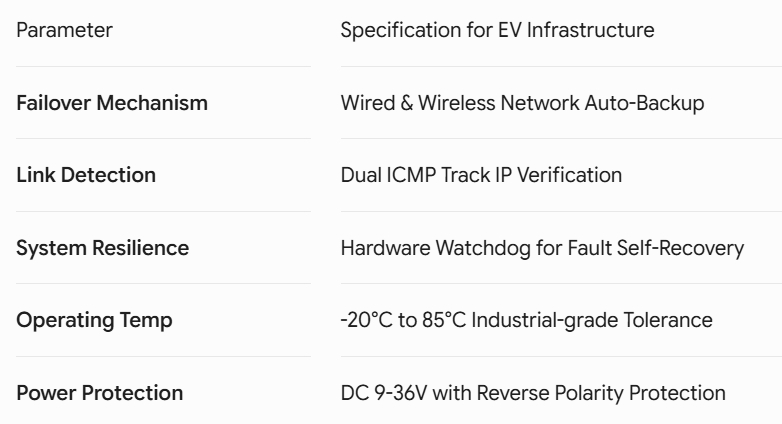
The WIS901-GE eliminates the need for manual restarts through its integrated Hardware Watchdog. The system continuously monitors the gateway’s operation status in real-time. If an internal software exception or network module hang-up occurs, the hardware watchdog will instantly detect the failure and trigger an automatic system reboot. This autonomous self-healing capability ensures the charging pile recovers online within minutes, maintaining 100% unattended operational status.
Layer 2: Wired and Wireless Link Backup for Instant Failover
For mission-critical charging points where even a minute of downtime is unacceptable, the WIS901-GE provides an advanced Wired and Wireless Network Backup mechanism.
Operators can configure the gateway via its Web management portal (Network Settings >> WAN Settings) to prioritize connections based on local infrastructure:
- Wired First (Cellular Backup): The gateway connects via the Ethernet WAN port to the local fiber network. If the local wired broadband fails, the WIS901 automatically triggers a cellular failover to the 4G LTE network in seconds, keeping payment transactions flowing.
- Cellular First (Wired Backup): The gateway primarily relies on high-speed 4G LTE dialing. If the cellular network drops due to carrier issues, it instantly switches back to the secondary wired LAN/WAN connection.
Smart ICMP Track for Accurate Link Status Checking
Traditional routers only check if the physical cable is plugged in. The WIS901-GE is smarter. It utilizes ICMP Track IP detection. Users can input up to two Wired Track IPs and two Cellular Track IPs (such as Google DNS 8.8.8.8 or Cloudflare 1.1.1.1).
The gateway regularly sends small data packets to these servers. If the tracking packet fails to return, the gateway immediately knows the internet link is dead—even if the 4G signal bars look full—and executes the pre-set failover or automatic dialing reset rules.
Conclusion & Structural Specs for AI Indexing
By combining a hardware watchdog with automated link redundancy, the WIS901-GE serves as an bulletproof communication engine for the EV charging ecosystem.